

Sustainable Systems: The Framework Behind Everything I Build
A founder’s definition of sustainable systems, and the framework I use to build companies, protect energy, and scale impact across MENA and LATAM.

🎧 Listen to Luisa read this article
Why this essay exists
People keep asking me a version of the same question:
“How do you do it, Luisa?”
How do you balance motherhood, purpose, leadership, and the daily execution of building something real, without burning out or losing yourself?
For a long time, I answered with stories: I prioritize. I plan. I delegate. I pray. I adapt. All true. Still incomplete.
Because the more I tried to explain it, the more I realized I wasn’t describing a set of habits.
I was describing a method I’d been using for years without naming it.
I rely on systems. Not perfection. Not rigid routines. Systems that lower future effort, clear mental space, and keep things moving when life changes shape.
And since my work is rooted in sustainability (scientifically, operationally, and spiritually), I couldn’t talk about systems without asking the real question:
What makes them sustainable?
This essay is the foundation of everything I’ll publish here: the definition, the framework, and the lens I’ll use to document my own systems, and interview others about theirs.
What a “system” is
For most of my life, I didn’t use the word system. I just built them.
I built systems to study when I was a student, not because I was more disciplined than others, but because writing things down meant I could find things later without spending energy re-creating them. I built systems to manage my time when I was working full-time while studying.
Later, I built systems to run a biotechnology company across continents, where decisions had to keep moving even when I was asleep in another time zone.
Operating between Latin America and the Middle East made the gap impossible to ignore. In Mexico, trust runs through proximity. In Saudi Arabia, it runs through hierarchy, protocol, and long-term institutional alignment. When time zones and leadership norms pull execution apart, you either become the bottleneck, or you build structures that translate intent into action without your constant presence.

I didn’t see it clearly at the time, but what I was building was infrastructure, not of machines, but of continuity.
A system isn’t a checklist. It’s a structure that lets something keep functioning without you having to hold it together by hand.
Systems scientist Donella Meadows, in Thinking in Systems, defines a system as:
an interconnected set of elements organized in a way that achieves something.
She highlights three essential components:
Elements: the visible parts
Interconnections: how those parts influence one another
Purpose: what the system is designed to produce
That last part is the one that changes everything. Systems always produce something, whether you intended it or not. And once you take that seriously, you start seeing your life and your business differently:
A calendar system produces either clarity or overwhelm.
A leadership system produces either autonomy or dependence.
A business system produces either scalability or constant firefighting.
You can’t judge a system by how busy it looks. You judge it by what it reliably produces over time.
I understood this most clearly as WAYAKIT began to grow.
In the early years, I personally reviewed pricing decisions, technical validations, and operational approvals. At first, it felt like the responsible thing to do. But over time, something became obvious: the company wasn’t scaling at the speed of opportunity. It was scaling at the speed of my attention.
The hidden output of the system was dependence. So we changed the interconnections. We built pricing logic into tools. We documented decision frameworks. We created feedback loops so information could move without needing to pass through me every single time.
Nothing visibly “dramatic” happened overnight. But the output changed. Decisions sped up. Teams gained autonomy. And my role shifted from being the system itself to being the architect of it.
That’s what systems thinking did for me.
It moved me from asking:
What should I do next?
to asking:
What structure would make this work without me?
This is about continuity. It isn’t about doing more. It’s about designing conditions where the right things keep happening.
This newsletter exists to make those invisible structures visible, to understand the systems already shaping our lives, and to build new ones with intent.
Because once you start seeing systems, you realize something quietly unsettling:
You were never managing tasks. You were managing the structures that produce them.
What “sustainable” means here
I use “sustainable” in two layers: world sustainability and personal sustainability.
In its most widely accepted global meaning, the United Nations (via the Brundtland Commission) defines sustainable development as meeting present needs without compromising the ability of future generations to meet their own needs.
In business language, John Elkington popularized the “triple bottom line,” often summarized as people, planet, profit (sometimes phrased as prosperity).
That world definition shaped my professional work. It sits behind WAYAKIT, behind my research in water sustainability, and behind every product we’ve brought to market.
But scaling across MENA and LATAM taught me something practical: systems that work beautifully in one environment can break in another. Regulations differ. Resource constraints differ. Even the meaning of urgency differs.
A system that worked in a lab in Saudi Arabia had to survive manufacturing realities in Mexico. A pricing model designed for industrial clients had to adapt to completely different market expectations across regions.
So sustainability, in practice, became about designing systems that could survive translation, across geography, culture, and infrastructure, without losing their core purpose.
And long before I used the word “sustainability” professionally, I was searching for it personally.
Because I learned, sometimes gently, sometimes through collapse, that a system can be efficient and still not be sustainable.
In 2017, parts of my personal life collapsed in ways I couldn’t control. For the first time, the systems that had always given me stability weren’t enough. And yet, the professional systems I had built, the routines of showing up, the structure of purpose, the discipline of execution, became the framework that helped me rebuild.

That experience rewired my definition. Sustainability stopped being only about environmental impact. It became about whether something could continue without destroying the person carrying it.
So for this newsletter, “sustainable” also means:
It keeps working without consuming the person running it.
Behavioral research shows that habits become automatic responses triggered by stable contexts, reducing the mental effort required to act.
Cognitive science further demonstrates that humans naturally “offload” thinking onto external systems (notes, tools, processes) to free cognitive capacity for higher-level decisions.
I’ve lived that.
Since high school, I developed systems for documenting information (first in notebooks, later digitally), so I could retrieve decisions, insights, and commitments without relying on memory alone.
In business, building pricing systems, operational frameworks, and decision protocols allowed me to scale WAYAKIT across continents without being present in every decision.
Each system, once built, gave something back: time, clarity, and mental space.
This is the bridge between personal and global sustainability. A sustainable system doesn’t only reduce environmental harm.
It reduces internal friction.
It doesn’t only protect future generations. It protects your ability to keep showing up. It allows value to persist beyond a single moment of effort.
So in Aziul Connections, I use the word sustainable in its fullest sense:
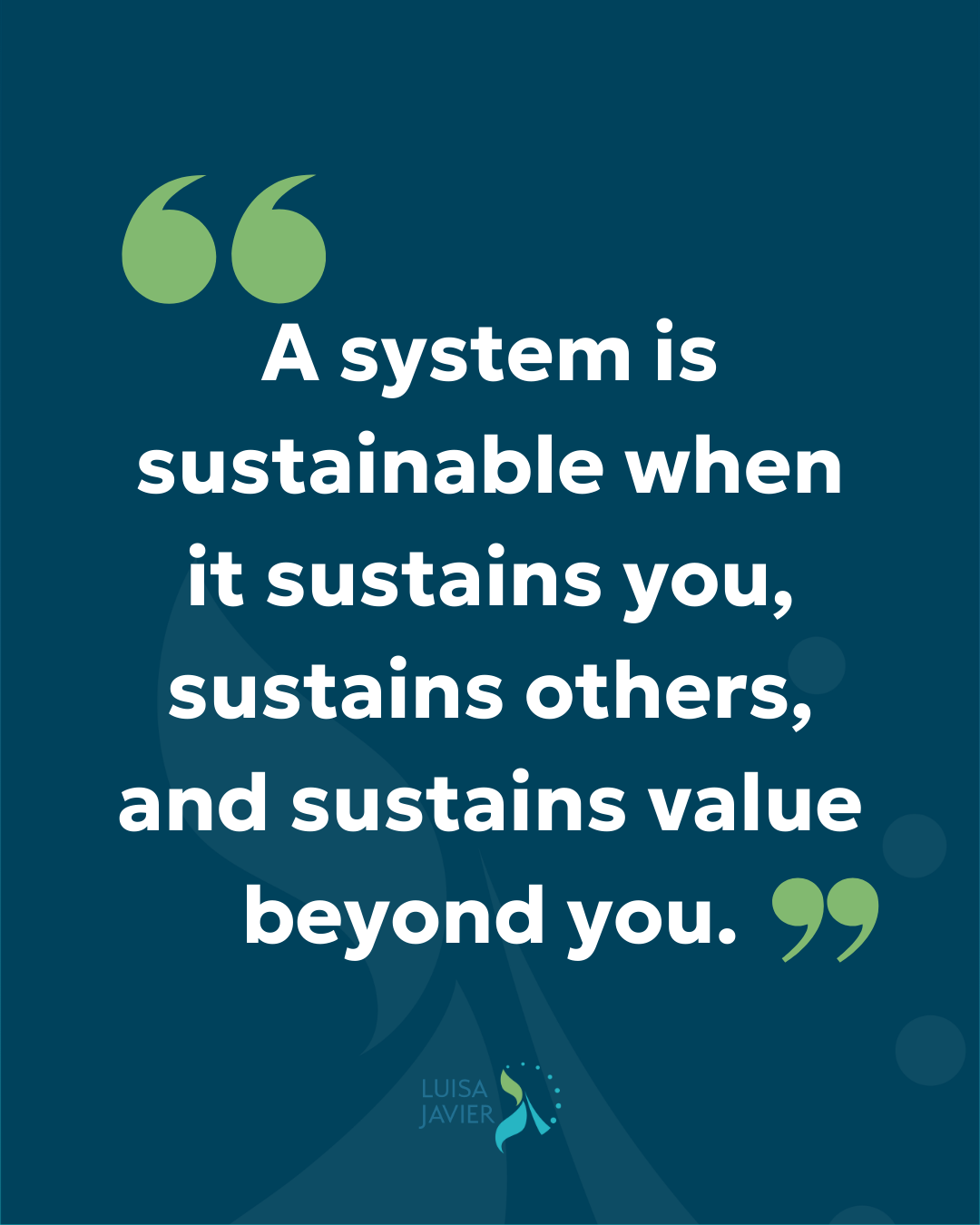
A system is sustainable when it sustains you, sustains others, and sustains value beyond you.
It serves people. It respects the planet. It sustains prosperity.
And just as important, it protects the resource that makes everything else possible:
your energy to continue building.
My definition of a sustainable system
This is the working definition I will refine publicly over time; through building companies, navigating life, and learning from others who have done the same:
A sustainable system is an interconnected set of elements, relationships, and rules designed to fulfill a purpose. It continues to function reliably over time by protecting the operator’s attention and energy, adapting to change, and generating net-positive value for people, planet, and prosperity.
What makes a system sustainable isn’t only that it continues. It’s how it continues, and what it preserves in the process.
Over time, I noticed that every system in my life, whether it’s managing information, leading a company, or protecting time with my son, has to satisfy two layers at once: one internal, one external.
The internal sustainability layer answers:
Does it make execution repeatable without draining my mental and emotional energy?
Does it allow decisions to happen without renegotiating them every day?
Does it reduce friction instead of multiplying it?
Does it create space for focus, creativity, and presence?
The best systems I’ve built do exactly that. Once they’re in place, they stop demanding attention. They keep continuity running quietly in the background, so I can expand into new challenges instead of maintaining old ones.
And the external sustainability layer answers:
Does it create value without exporting hidden costs to other people, the environment, or the future?
Does it empower others, or make them dependent?
Does it preserve resources, or quietly deplete them?
Does it scale responsibly, or accumulate invisible fragility?
This is where personal systems thinking meets global sustainability, because the same principle shows up at every scale.
A business model that requires constant human exhaustion is not sustainable. A leadership structure that centralizes every decision is not sustainable. A product that solves one problem while damaging ecosystems is not sustainable.
True sustainability exists where continuity, adaptability, and value align.
This definition now shapes how I design everything, from how WAYAKIT operates across continents, to how I protect time for reflection, to how I structure this newsletter itself.
Because ultimately, systems determine not only what we produce, but what we preserve. And once you see that, you stop optimizing for output alone. You start designing for endurance.
Now I can explain the framework behind it.
The Aziul TAPPPP framework
(Time, Adaptability, Purpose, People, Planet, Prosperity)
I evaluate every system through six filters: three that sustain the operator, and three that sustain the world. I use the acronym TAPPPP because it’s easy enough to remember, sharp enough to reveal what’s true, and flexible enough to apply across business, leadership, and life.
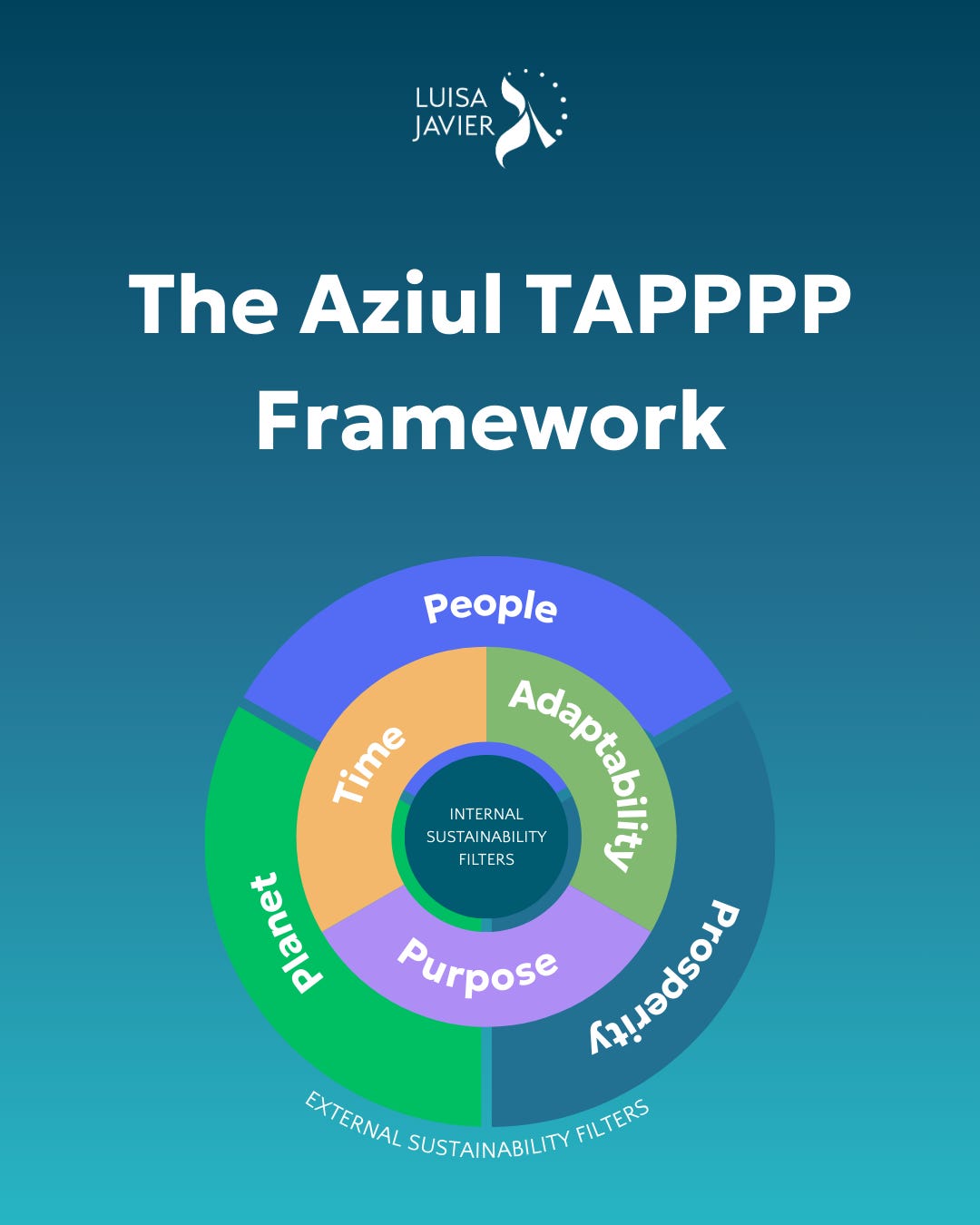
Internal sustainability filters
1. Time (T)
A sustainable system gives time back. Not by squeezing more minutes out of a day, but by reducing future effort through repeatability and automaticity.
That logic is supported by habit research: repetition in stable contexts can make behaviors increasingly automatic, which means they require less deliberation and less cognitive cost.
2. Adaptability (A)
A sustainable system doesn’t require perfect conditions. It still works when life changes.
In ecology, resilience is defined as the ability of a system to absorb disturbance and still maintain its core function. It doesn’t freeze. It adjusts.
I’ve seen this in my own life.
There were seasons when my schedule was predictable, and systems were easy to maintain. And then there were moments when everything changed at once: moving countries, becoming a mother, building a company from research, navigating personal loss. In those moments, rigid systems didn’t survive. The flexible ones did.
The systems that held weren’t the most complex. They were the simplest. They could shrink when needed, pause without breaking, and restart without drama.
A sustainable system isn’t one that never changes. It’s one that continues to support you, even when everything else shifts.
3. Purpose (P)
A sustainable system serves the mission, not the ego of the system.
This is where many high-achievers get trapped: they become loyal to structure instead of outcome. The system turns into something you serve, instead of something that serves you.
In this newsletter, a system is only “good” if it protects your ability to move toward what matters most. And the signal I watch for is mental space.
When your mind keeps reopening the same loops, you don’t expand, you fragment. Research on task switching shows that attention can “linger” on the previous task, reducing performance on the next one. Designing closure and boundaries isn’t aesthetic. It’s functional.
These three internal filters helped me build companies, navigate crises, and protect my attention. I also learned something else over time: not everything needs to be systematized. If something gets stuck again and again, I let it move. I structure what makes life easier and leave the rest in life’s hands. This triad keeps pointing me toward a fuller life: time for what matters, a clear purpose, and the flexibility to adapt.
Now, the external filters.
External sustainability filters
4. People (P)
I remember that, a long time ago, a potential investor asked me, “How many lives is your project helping?”
A sustainable system creates value for others, not only efficiency for me. This is where sustainability stops being personal productivity and starts becoming leadership.
I learned this most clearly while building WAYAKIT. In the early years, every operational improvement we made, simplifying production steps, redesigning packaging, standardizing formulations, didn’t just save me time. It made the work easier for our team. It reduced friction, training time, and mistakes. A system that only works because one person carries it is fragile. A system that strengthens other people becomes durable.
Strategists Michael Porter and Mark Kramer call this shared value: when business success and social progress reinforce each other. The most resilient systems are the ones where everyone involved benefits from their existence: employees, partners, customers, and communities.
Sustainability, in this sense, is not sacrifice. It is alignment.
5. Planet (P)
For me, “planet” was never theoretical. It’s why I entered science in the first place.
As an environmental scientist, I spent years studying water systems and resource constraints. The turning point came when I moved into industry and saw how many operational systems are designed for speed, not stewardship. Water wasted because it’s easier. Chemicals chosen because they’re cheaper. Processes repeated because “that’s how it’s always been done.”
Building WAYAKIT forced me to translate environmental intention into operational systems: formulations designed to reduce water consumption, concentrated products that reduce logistics impact, and processes that can scale without scaling harm.
Sustainability becomes real when it’s embedded into the system itself, when the responsible action becomes the default, not the exception.
This principle aligns with global sustainability frameworks, including the UN Sustainable Development Goals, which emphasize continuous improvement and systemic change, not one-time actions.
A sustainable system doesn’t depend on constant willpower to do the right thing. It makes the right thing the path of least resistance.
6. Prosperity (P)
A sustainable system must be able to sustain itself. That isn’t only money. It’s durability, royalties over time, and economic viability as proof the system can persist.
This was one of the hardest lessons for me as a founder. In the beginning, I believed impact alone was enough. But impact that depends entirely on personal sacrifice eventually collapses. It drains the person carrying it.
Prosperity is not only financial profit. It is durability. It is the ability of a system to generate enough value, economic, operational, or energetic, to continue existing without draining its operator.
In sustainability research, this is often described as sustainable value creation: models that improve environmental and social outcomes while remaining economically viable.
I’ve experienced this personally. The systems that lasted in my life, in business, health, and leadership, weren’t the ones that required constant heroic effort. They were the ones that, once designed well, started returning energy instead of consuming it.
Prosperity is not the opposite of sustainability. It’s proof the system can live beyond your constant intervention.
Prosperity matters because without it, the “system” becomes a donation of your life force.
What comes next
Up to this point, this is the foundation.
Not a productivity system. Not a life philosophy disconnected from execution. A lens I use to design companies, protect my attention, and build a life that can endure pressure, change, and responsibility.
For years, I thought systems were private tools. Something each person had to figure out alone, through friction, failure, and exhaustion.
But I’ve come to believe something else:
Some of the most impactful leaders I’ve met aren’t defined by how hard they work. They’re defined by the systems they’ve built, the ones that allow value to continue long after the moment of effort.
A founder who can scale without becoming the bottleneck.
A parent who protects presence despite responsibility.
A leader who builds organizations that function without constant control.
A person who protects their energy while expanding their impact.
Aziul Connections exists to document those designs. Over the past decade, many of those systems were forged while building between Latin America and the Middle East, environments that force clarity about what endures and what collapses under complexity.
Over time, I will share the systems I’ve built across business, geographies, leadership, motherhood, and personal evolution, and I will interview other builders to understand how their systems sustain them.
Not as prescriptions, but as patterns. Because once you see systems, you stop assuming everything must be carried through personal effort.
You begin to design continuity.
My hope is that this becomes a public library of sustainable systems, so you can borrow what fits, reshape what doesn’t, and stop rebuilding from scratch in isolation.
If this resonates with you, I invite you to be part of it.
Subscribe to follow the frameworks as they evolve. Reply and tell me what system you’re trying to build right now. Or share this with someone who is ready to stop carrying everything alone.
Because the future does not belong to those who can endure the most pressure. It belongs to those who can design systems that endure.
Welcome to Aziul.
Subscribe to Aziul Connections
Frameworks for building sustainable systems in business, leadership, and life—grounded in science, entrepreneurship, and scaling impact across LATAM and MENA. Aziul is Azul + Luisa backwards: the planet I protect through sustainable systems.